German A1 is where you learn to introduce yourself, give your address, order in a café, find the station, and fill in a simple form. The vocabulary isn't huge. The trap is everything attached to each noun: whether it's der, die, or das, and what the plural looks like. Learn Tisch without der and Tische, and you'll be guessing for years.
This post covers what A1 means, what's in our free German A1 deck, a 30-day study plan using FSRS spaced repetition, and how free German audio helps. For the general app comparison, see the best flashcard app for language learning.
What A1 means
A1 is the first of the six CEFR levels (A1 to C2). The Council of Europe calls it "Breakthrough", the entry point of the "Basic User" band (Council of Europe). An A1 learner can use familiar everyday expressions and very basic phrases, introduce themselves, and handle a simple conversation if the other person speaks slowly and helps out.
How many words is that? The CEFR doesn't say. It describes what you can do, not how many words you know, and the estimates you'll find online vary widely. Be wary of any site that quotes an exact number.
The best-known A1 exam is the Goethe-Institut's Goethe-Zertifikat A1: Start Deutsch 1. It has four parts (Goethe-Institut):
| Part | What you do | Time |
|---|---|---|
| Reading | Short notes, ads, signs, and posters | 25 min |
| Listening | Short everyday announcements and conversations | about 20 min |
| Writing | Fill in a simple form and write a short text | 20 min |
| Speaking | Introduce yourself and ask and answer questions, in a group | about 15 min |
Exam formats and pass rules can vary by provider and change over time, so confirm the details with your local Goethe-Institut before you register. telc and ÖSD also offer A1 exams, if one of those is easier to book where you live.
What's in the free deck
The German A1 Starter deck has 300 cards in fifteen themes. The cards are arranged theme by theme, in this order:
| Theme | Cards | Examples |
|---|---|---|
| Greetings & Introductions | 20 | Hallo, Guten Tag, kennenlernen |
| Personal Info | 20 | der Mann, verstehen, der Wohnort |
| Numbers, Dates & Time | 30 | zwei, drei, spät, früh |
| Family & Friends | 20 | die Familie, die Mutter, heiraten |
| Food, Drink & Eating | 30 | das Brot, die Rechnung, bestellen |
| Home & Furniture | 20 | das Haus, der Garten, der Kühlschrank |
| School & Work | 20 | die Schule, die Universität, verdienen |
| Hobbies & Leisure | 20 | das Hobby, die Musik, der Urlaub |
| Places & Directions | 15 | der Platz, geradeaus, die Ecke |
| Transport & Travel | 15 | das Auto, der Bus, umsteigen |
| Shopping & Clothes | 20 | das Geschäft, der Laden, teuer |
| Common Verbs | 30 | sein, haben, fragen, antworten |
| Adjectives & Opposites | 20 | groß / klein, schwer / leicht |
| Weather, Nature & Seasons | 10 | das Wetter, die Sonne, der Winter |
| Question Words & Survival | 10 | wer, was, Hilfe!, Ich verstehe nicht. |
The front shows the German. Every noun carries its article and its plural, so you learn all three together. Nouns without a plural say so ("das Wetter, (kein Plural)"). The back has the English meaning and an example sentence with its translation:
der Tisch, die Tische → the table Der Tisch ist aus Holz. — The table is made of wood.
Every card also has a note, and that's where the patterns live:
- Gender rules: all -ung nouns are feminine (die Rechnung, die Wohnung), and -chen makes a noun neuter and small (das Brötchen).
- Separable verbs, shown split: einkaufen → Ich kaufe im Supermarkt ein. aufstehen → Ich stehe um sieben auf.
- False friends: bekommen means to receive, not to become (that's werden).
- Conjugations: sein, haben, werden, and all six modal verbs have their present tense on the card. können gives you ich kann, du kannst, er kann, wir können, ihr könnt, sie können.
The deck downloads as .apkg or .csv, so it works in MintDeck or Anki.
A 30-day FSRS study plan
MintDeck schedules every review with FSRS, which brings each card back just before you'd likely forget it. Your one decision is the pace of new cards, under Settings → Daily Goal → New cards per day (5 to 50, in steps of 5).
At 10 new cards a day, 300 cards take 30 days. Roughly:
Days 1–7: Greetings, personal info, numbers. Enough to introduce yourself, say where you live, and give a phone number or a time.
Days 8–14: Family, food, home. Keep clearing the reviews FSRS brings back. They shrink as the early cards settle.
Days 15–21: School & work, hobbies, places, transport. Separable verbs start showing up (umsteigen, to change trains). Say the example sentence, with the prefix at the end, every time.
Days 22–30: Shopping, common verbs, adjectives, weather, survival. Then lower new cards and let reviews run.
Two habits make this work:
- Practise both directions. The per-session Reverse front and back toggle shows "the table" and asks you for der Tisch, die Tische. If you can produce the article and plural from the English, you know the word. Recognising it isn't enough.
- Count the article as part of the answer. If you got Tisch but said die, tap "Again". Grading yourself strictly on gender is the whole point of this deck.
Free German audio
German is read aloud free in MintDeck. The On-Device voices cover 31 languages, German included. They run on your phone, work offline, and cost no credits. Apple's built-in System Voiceover is free as well and reads German too.
German spelling is fairly regular once you know the rules, but umlauts, ch, and long versus short vowels are easier to get right when you've heard them on every review.
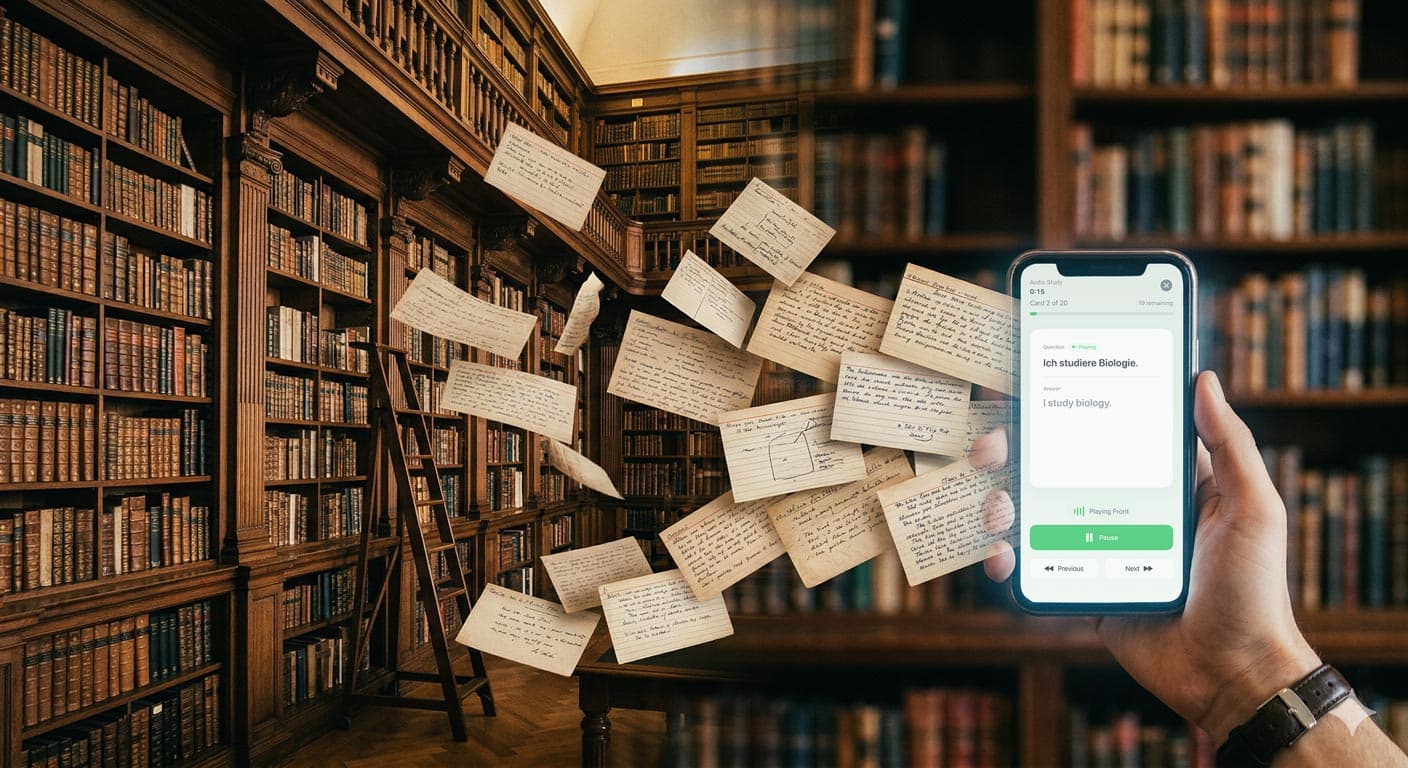
For review away from your desk, Audio Study reads your cards aloud and pauses for you to recall the answer. Front + Back mode reads the German, pauses, then reads the back, which works well on a walk or commute.
How this compares with other options
| MintDeck + this deck | Anki shared decks | Quizlet | Duolingo | Memrise | |
|---|---|---|---|---|---|
| Your own cards | Yes | Yes | Yes | No | Word lists |
| Scheduling | FSRS | FSRS (optional) or SM-2 | Own system | Own system | Own system |
| Article + plural on every noun | Yes | Depends on deck | Depends on set | Taught in lessons | Taught in lessons |
| iPhone cost | Free | AnkiMobile $24.99 | Free + paid plan | Free + paid plan | Free + paid plan |
Anki shared decks. AnkiWeb has many free German decks, some very large, and quality varies. Anki's scheduler is excellent, and Anki is free on desktop and Android. MintDeck imports .apkg files, so you can move an existing deck over with its review history.
Quizlet. Lots of user-made German sets, and handy for class lists. Plenty of them leave out plurals or articles. Learn mode sits behind Quizlet Plus, a paid plan. If you already have sets, you can bring them into MintDeck.
Duolingo. Strong for a daily habit and a guided path through German, with audio throughout. You can't add your own cards or import a deck, so it can't drill the specific genders you keep getting wrong. Use it alongside a deck, not instead of one.
Memrise. Its official courses lean on native-speaker audio and video, which is better listening practice than any flashcard deck. It's a course, though, not a place to keep and schedule your own vocabulary.
How to set up MintDeck for German A1
- Download MintDeck from the App Store. It's free.
- Get the deck. Download the
.apkgfrom the German A1 Starter page. - Import it. In MintDeck, go to Decks → + → Import → Anki Deck, check the preview, then import.
- Set your pace. Settings → Daily Goal → New cards per day. Start at 10.
- Turn on audio. Choose the free On-Device voice under Settings → Voice & Sound. In Audio Study, each side has its own spoken language: set the front to German if it isn't picked up automatically.
- Add your own words. When your course or a conversation hands you a word that isn't in the deck, make a card with its article and plural the same day.
What it costs
Importing this deck, reviewing with FSRS, the free voices, and Audio Study are all free and unlimited. Credits only pay for optional AI generation, such as turning a page of your textbook into cards, and you start with 10. Full breakdown: what's free and what costs credits.
The bottom line
A1 German comes down to a few hundred words, but each noun is really three facts: the word, its article, and its plural. A deck that puts all three on the front, explains the pattern in a note, and shows separable verbs split in a real sentence covers that ground in a month at 10 new cards a day. Pair it with listening practice and the exam's model papers if you're sitting Start Deutsch 1.
More language guides: French vocabulary flashcards · Spanish vocabulary flashcards · Best flashcard app for language learning · Exam & language-learning setup · Hands-free Audio Study
Compare apps: MintDeck vs Anki · MintDeck vs Quizlet
Frequently asked questions
- How many words do you need for German A1?
- The CEFR doesn't set a word count. It describes each level by what you can do, and published vocabulary estimates for A1 vary a lot. A few hundred high-frequency words, each learned with its article and plural, cover the everyday situations A1 is about.
- What is in the free MintDeck German A1 deck?
- 300 German words and phrases in fifteen themes, from Greetings & Introductions to Question Words & Survival. Every noun shows its article and plural (der Tisch, die Tische), and every card has the English meaning, an example sentence with its translation, and a note on gender, separable verbs, false friends, or conjugation.
- Is this deck enough to pass the Goethe-Zertifikat A1?
- No single vocabulary deck is. The Goethe-Zertifikat A1: Start Deutsch 1 tests reading, listening, writing, and speaking, and the speaking part is taken in a group. Use the deck for vocabulary and practise the exam tasks with the official model papers.
- Can MintDeck read German flashcards aloud for free?
- Yes. MintDeck's free On-Device voices speak German, offline and without credits. Apple's built-in System Voiceover, also free, reads German too.
Written by
Sergiu Puscas · Creator of MintDeck
Sergiu builds MintDeck and writes every guide and comparison on this blog — drawing on building an FSRS-based flashcard app and hands-on testing of the study apps covered here.
More about Sergiu