French A1 is where you go from zero to getting by: saying hello properly, giving your name and address, ordering a coffee, buying a train ticket, asking what something costs. All of it rests on a few hundred very common words and the small details around them, like which article a noun takes and which verbs refuse to follow the rules.
This post covers what A1 means, what's in our free French A1 deck, a 30-day study plan using FSRS spaced repetition, and how free French audio helps. For the general app comparison, see the best flashcard app for language learning.
What A1 means
A1 is the first of the six CEFR levels (A1 to C2). The Council of Europe calls it "Breakthrough", the entry point of the "Basic User" band (Council of Europe). An A1 learner can use familiar everyday expressions and very basic phrases, introduce themselves, and handle a simple conversation if the other person speaks slowly and helps out.
How many words is that? The CEFR doesn't say. It describes what you can do, not how many words you know, and the estimates you'll find online vary widely. Be wary of any site that quotes an exact number. A few hundred high-frequency words, learned with their gender and in a sentence, is a realistic target.
If you're aiming for the DELF A1, the exam run by France Éducation international, it has four tests, each marked out of 25 (France Éducation international):
| Test | Format | Time |
|---|---|---|
| Listening comprehension | Group, short recordings | about 20 min |
| Reading comprehension | Group | 30 min |
| Written production | Group: a form and a short message | 30 min |
| Spoken production | Individual, with two examiners | 5–7 min + 10 min preparation |
You need 50 out of 100 to pass, and at least 5 out of 25 in every test. A strong reading score can't rescue a test you skipped. Check the official page for current dates and fees before you register.
What's in the free deck
The French A1 Starter deck has 300 cards in twelve themes. The cards are arranged theme by theme, in this order:
| Theme | Cards | Examples |
|---|---|---|
| Greetings & Politeness | 20 | bonjour, s'il vous plaît, à demain |
| Personal Info & Identity | 25 | le nom, le prénom, le travail |
| Numbers & Time | 30 | zéro, le matin, le soir |
| Family | 20 | la mère, le père, le voisin |
| Food & Drink | 35 | le pain, le beurre, boire |
| Places & Transport | 30 | la maison, l'appartement, le jardin |
| Daily Life & Routines | 30 | se lever, se laver, le ménage |
| Common Verbs | 35 | être, avoir, aller, voyager |
| Adjectives & Descriptions | 25 | grand, petit, propre |
| Shopping & Colors | 20 | le supermarché, le sac, jaune |
| Weather & Nature | 15 | le temps, le soleil, la rivière |
| Question Words & Survival Phrases | 15 | qui, C'est combien ?, Pouvez-vous m'aider ? |
The front shows the French, with the article on every noun so you learn the gender along with the word (le pain, la maison). The back has the English meaning and an example sentence with its translation:
le pain → bread J'achète du pain frais. — I buy fresh bread.
What sets this deck apart is the note on every card. Some flag a false friend ("pain" is bread; physical pain is la douleur). Some explain usage (bonsoir is for arriving in the evening, not leaving). The irregular verbs carry their full present tense, so the être card gives you je suis, tu es, il est, nous sommes, vous êtes, ils sont. The aller card adds that aller + infinitive forms the near future.
The deck downloads as .apkg or .csv, so it works in MintDeck or Anki.
A 30-day FSRS study plan
MintDeck schedules every review with FSRS, which brings each card back just before you'd likely forget it. Your one decision is the pace of new cards, under Settings → Daily Goal → New cards per day (5 to 50, in steps of 5).
At 10 new cards a day, 300 cards take 30 days. Roughly:
Days 1–7: Greetings, personal info, numbers. The words you'll use in your first real conversation. Say each example sentence out loud.
Days 8–14: Family, food & drink, places. Keep clearing the reviews FSRS brings back. They shrink as the early cards settle.
Days 15–21: Daily routines and common verbs. This is the hardest week. Read the conjugation in the note every time an irregular verb comes up, not just the meaning.
Days 22–30: Adjectives, shopping, weather, survival phrases. Then lower new cards and let reviews run.
Two habits make this work:
- Practise both directions. The per-session Reverse front and back toggle shows "bread" and asks you for le pain, article included. Getting the gender right when you produce a word is a different skill from recognising it.
- Rate honestly. Tapping "Good" on a word you barely remembered pushes it too far out. "Hard" or "Again" is the right answer when you hesitated or got the gender wrong.
Free French audio for pronunciation
French is covered by MintDeck's free On-Device voices. They run on your phone, work offline, and cost no credits.
French spelling and sound part ways often: silent final letters, liaison, nasal vowels like the ai in pain. Hearing each word every time you review it is how the written form and the sound end up attached in your memory.
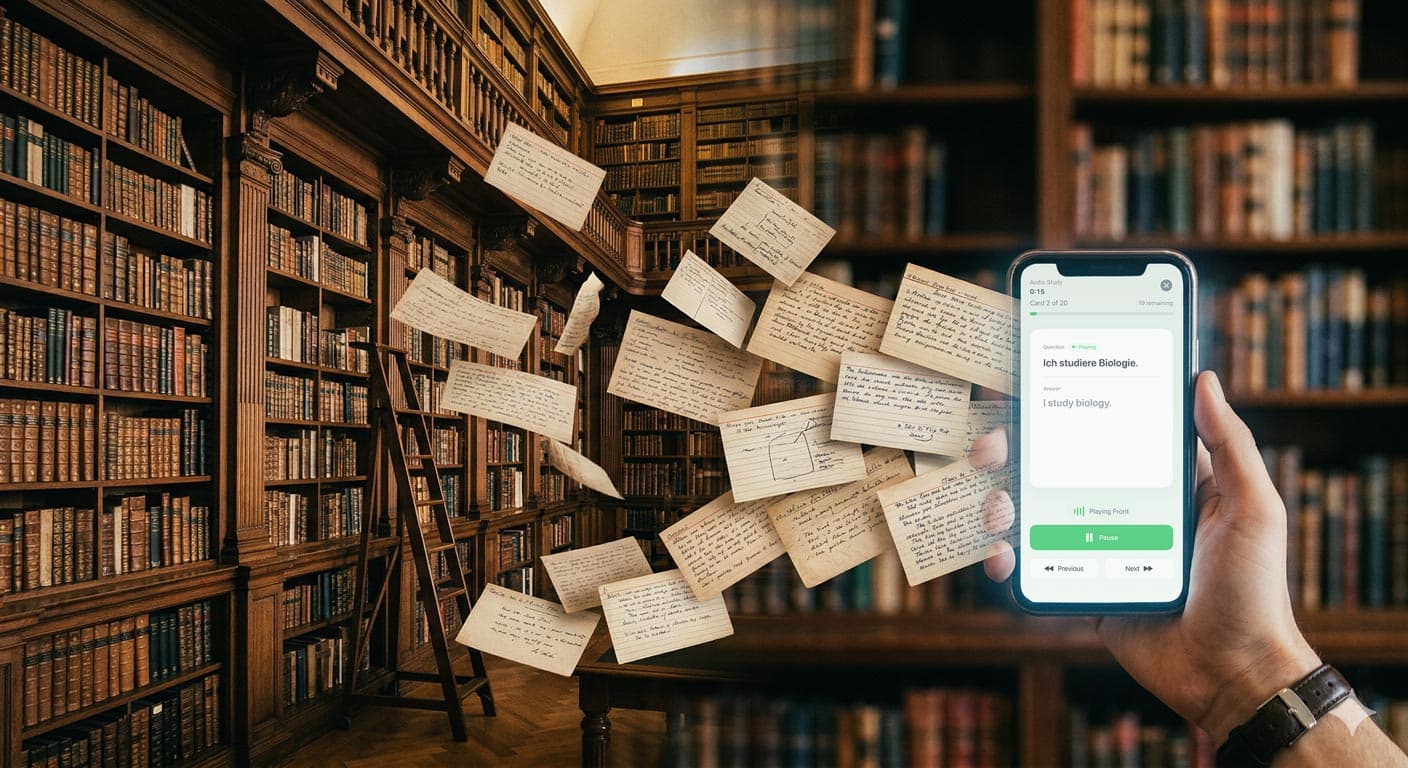
For review away from your desk, Audio Study reads your cards aloud and pauses for you to recall the answer. Front + Back mode reads the French, pauses, then reads the back, which works well on a walk or commute.
How this compares with other options
| MintDeck + this deck | Anki shared decks | Quizlet | Duolingo | Memrise | |
|---|---|---|---|---|---|
| Your own cards | Yes | Yes | Yes | No | Word lists |
| Scheduling | FSRS | FSRS (optional) or SM-2 | Own system | Own system | Own system |
| Free French audio | Yes, offline | Depends on deck | Yes | Yes | Yes |
| iPhone cost | Free | AnkiMobile $24.99 | Free + paid plan | Free + paid plan | Free + paid plan |
Anki shared decks. AnkiWeb has many free French decks, and quality varies. Anki's scheduler is excellent, and Anki is free on desktop and Android. MintDeck imports .apkg files, so you can move an existing deck over with its review history.
Quizlet. Plenty of user-made French sets, and good for quick class lists. Learn mode sits behind Quizlet Plus, a paid plan. If you already have sets, you can bring them into MintDeck.
Duolingo. Strong for a daily habit and a guided path through French, with audio throughout. You can't add your own cards or import a deck, so it can't drill the specific words you keep missing. Use it alongside a deck, not instead of one.
Memrise. Its official French course leans on native-speaker audio and video clips, which is something a flashcard deck can't match for listening practice. It's a course, though, not a place to keep and schedule your own vocabulary.
How to set up MintDeck for French A1
- Download MintDeck from the App Store. It's free.
- Get the deck. Download the
.apkgfrom the French A1 Starter page. - Import it. In MintDeck, go to Decks → + → Import → Anki Deck, check the preview, then import.
- Set your pace. Settings → Daily Goal → New cards per day. Start at 10.
- Turn on audio. Choose the free On-Device voice under Settings → Voice & Sound. In Audio Study, each side has its own spoken language: set the front to French if it isn't picked up automatically.
- Add your own words. When a course, a show, or a conversation hands you a word that isn't in the deck, make a card for it the same day.
What it costs
Importing this deck, reviewing with FSRS, the free On-Device French voice, and Audio Study are all free and unlimited. Credits only pay for optional AI generation, such as turning a page of your textbook into cards, and you start with 10. Full breakdown: what's free and what costs credits.
The bottom line
A1 French is mostly a vocabulary problem, with gender and a handful of irregular verbs as the traps. A 300-card deck that shows the article on every noun, puts each word in a sentence, and explains the catch on every card covers that ground in a month at 10 new cards a day. Pair it with listening practice and the DELF task types if you're sitting the exam.
More language guides: Spanish vocabulary flashcards · German vocabulary flashcards · Best flashcard app for language learning · Exam & language-learning setup · Hands-free Audio Study
Compare apps: MintDeck vs Anki · MintDeck vs Quizlet
Frequently asked questions
- How many words do you need for French A1?
- The CEFR doesn't set a word count. It describes each level by what you can do, and published vocabulary estimates for A1 vary a lot. A few hundred high-frequency words and set phrases, learned well, cover the everyday situations A1 is about.
- What is in the free MintDeck French A1 deck?
- 300 French words and phrases in twelve themes, from Greetings & Politeness to Question Words & Survival Phrases. Nouns show their gender (le / la / l'), and every card has the English meaning, an example sentence with its translation, and a note such as a false-friend warning or a conjugation.
- Is this deck enough to pass DELF A1?
- No single vocabulary deck is. DELF A1 has four tests (listening, reading, writing, and speaking), each marked out of 25. You need 50 out of 100 overall and at least 5 out of 25 in every test. Use the deck for vocabulary and practise the exam tasks separately.
- Can MintDeck read French flashcards aloud for free?
- Yes. French is covered by MintDeck's free On-Device voices. They run offline and cost no credits, including in hands-free Audio Study.
Written by
Sergiu Puscas · Creator of MintDeck
Sergiu builds MintDeck and writes every guide and comparison on this blog — drawing on building an FSRS-based flashcard app and hands-on testing of the study apps covered here.
More about Sergiu