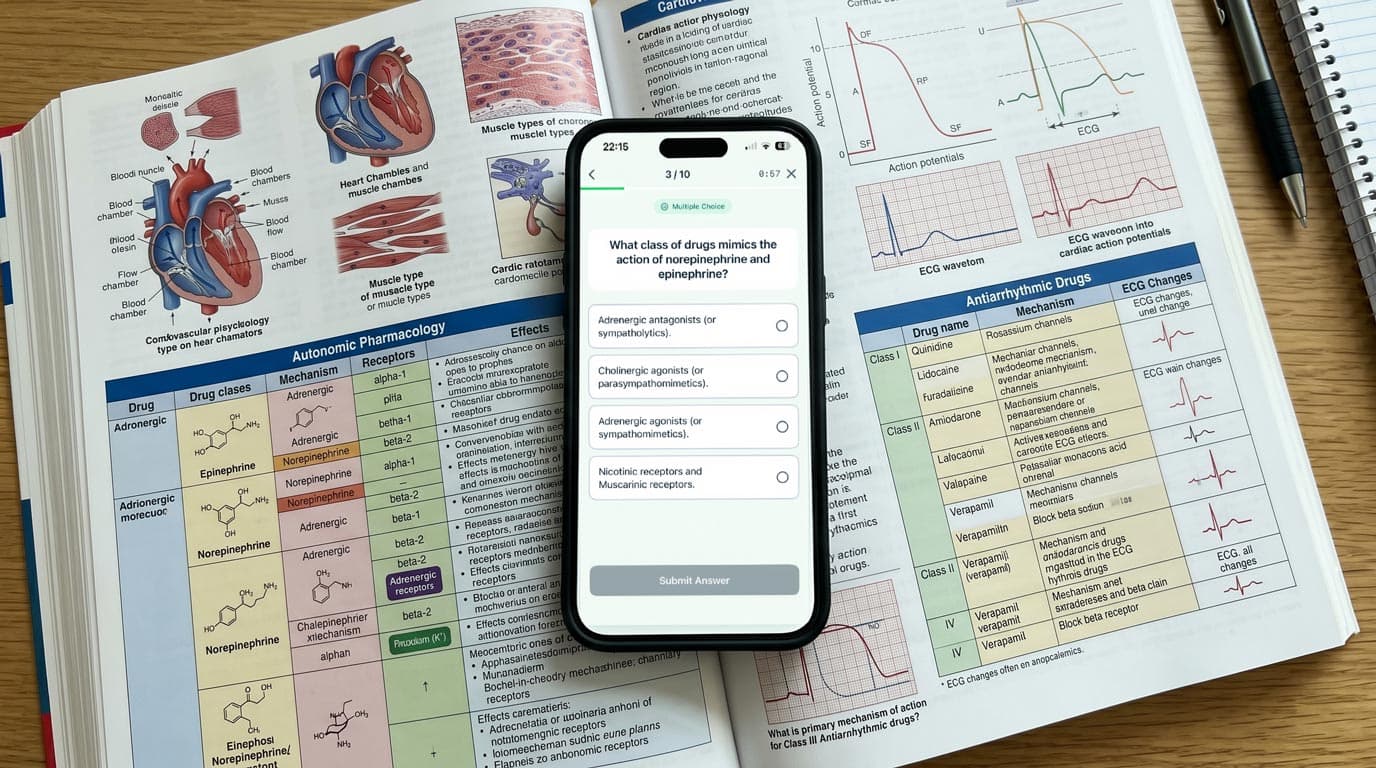
Pharmacology is where a lot of health sciences students first hit the limits of rereading notes. You need hundreds of drug names, each attached to a class, a mechanism, the conditions it treats and the side effects you'll be asked about, and all of it has to come back on demand. That's a retrieval problem, and flashcards with spaced repetition are built for it.
This guide gives you a free starting deck and a way to study it that works for nursing, pharmacy, PA and medical students.
The deck: Pharmacology: Top 100 Drugs is free to download as .apkg (for MintDeck or Anki) or .csv. It has 196 cards covering 100+ commonly taught drugs.
What's in the free Top 100 Drugs deck
Every card uses the same format. The front shows the generic name with common brand names, for example Lisinopril (Prinivil, Zestril). The back gives four things in a fixed order: Class, MOA (mechanism of action), Uses, and SE (side effects). The consistent layout matters, because after a few days you start predicting the back before you flip.
| Topic | Cards | What it covers |
|---|---|---|
| Antimicrobials | 35 | Penicillins, cephalosporins, macrolides, fluoroquinolones, antifungals, antivirals |
| Cardiovascular | 32 | ACE inhibitors, ARBs, beta-blockers, statins, anticoagulants |
| CNS | 31 | Antidepressants, antipsychotics, anxiolytics, antiepileptics |
| Gastrointestinal | 17 | PPIs, H2 blockers, antiemetics, laxatives, IBD therapies |
| Endocrine | 16 | Diabetes drugs, thyroid, corticosteroids, sex hormones |
| Respiratory | 13 | Bronchodilators, inhaled steroids, leukotriene modifiers |
| Analgesics | 12 | NSAIDs, opioids, neuropathic pain agents |
| Autoimmune | 9 | DMARDs, biologics, gout therapies |
| Oncology | 8 | Core chemotherapy and targeted agents |
| Other | 23 | Antihistamines, anaphylaxis, ophthalmic agents and other essentials |
| Total | 196 |
A few drugs appear twice on purpose, from different angles. Methotrexate has one card as a DMARD and another as high-dose chemotherapy with leucovorin rescue; prednisone appears under respiratory and again as a systemic corticosteroid. The deck also keeps a few drugs you'll still see in older material, such as ranitidine, with a note that it was withdrawn from the US market.
What the deck isn't: it doesn't cover doses, nursing interventions, monitoring parameters or drug interactions in depth, and it isn't clinical guidance. It's the recall layer underneath those things. Always check current prescribing information for anything you'd act on.
How to study pharmacology with flashcards
Learn the class before the drug. Most of what an exam asks about a drug follows from its class. Suffixes give you a head start: -pril (ACE inhibitors), -sartan (ARBs), -olol (beta-blockers), -statin (HMG-CoA reductase inhibitors), -prazole (PPIs). Watch the look-alikes: -azole usually means an antifungal like fluconazole, but omeprazole is a PPI and metronidazole is an antibiotic. Exceptions like that are exactly what's worth a card. Study one system at a time so the class pattern builds up before you mix them.
Then learn the exceptions. The high-yield facts are usually where a drug breaks its class pattern or carries a signature side effect: the dry cough and angioedema with ACE inhibitors, masked hypoglycemia with beta-blockers, the narrow therapeutic window with lithium or digoxin. When you keep missing one of these, split it into its own card. A card that asks one question is easier to get right and easier to schedule.
Say the answer before you flip. Recognition feels like knowing. Retrieval is what the exam measures. Say the class, mechanism, one use and one side effect out loud, then check.
Rate honestly. With FSRS, the rating you give decides when the card comes back. If you only half-remembered the side effects, press Hard or Again. Rating generously just means you'll meet the card again on exam day instead of in review.
Keep daily volume sustainable. Start with 10 to 20 new cards a day. At that pace the deck is fully introduced in two to three weeks, and your daily reviews stay short enough to keep doing.
Pharmacology flashcards by program
The same deck serves different programs, but what you add on top differs.
- Nursing students: the deck gives you class, mechanism and side effects. Add cards for the nursing layer: what to assess before giving the drug, what to monitor, and what to teach the patient. The NCLEX-RN guide covers how flashcards fit alongside clinical judgment questions, and the free NCLEX-RN Essentials deck adds lab values and safety content.
- Pharmacy students: you'll need much more depth than a top-100 deck, including interactions, dosing and counseling points. NABP describes the NAPLEX as a six-hour, 225-question computer-based exam; confirm current details on nabp.pharmacy. Use this deck as a warm-up and build your own cards from coursework.
- PA students: pharmacology runs through every system on the PANCE. Study each system's drug cards alongside that system's medicine block. See the PA school flashcard guide.
- Medical students: the deck is foundation material for Step 1 pharmacology, not a board deck. The USMLE Step 1 guide covers where Anki and AnKing still lead and how MintDeck fits.
Where to study: MintDeck, Anki, Quizlet and Brainscape
| MintDeck | Anki | Quizlet | Brainscape | |
|---|---|---|---|---|
| Scheduler | FSRS (on by default) | FSRS (optional) or SM-2 | Proprietary | Confidence-based (proprietary) |
| Can import this deck | Yes (.apkg or .csv) | Yes (.apkg) | Paste-in text import | No .apkg import |
| iPhone price | Free (credits only for AI) | AnkiMobile $24.99 | Free tier; paid plan | Free tier; paid subscription |
| Shared pharmacology content | Free decks, AI generation | Large community decks | Many user-made sets | Curated decks |
| Platforms | iOS | Desktop, Android, iOS, web | Web, iOS, Android | Web, iOS, Android |
Anki is free on desktop and Android and has the biggest library of shared medical decks, plus add-ons. If you're already invested in it, the .apkg from the deck page works there too. Quizlet is easy for quick class sets, but several study modes sit behind a paid plan and it isn't built on a published spaced repetition algorithm. Brainscape suits students who want curated, publisher-made content on a subscription. Plans change often, so check each app's pricing page.
MintDeck is an iPhone and iPad app with FSRS on by default. Studying, importing, manual cards, image occlusion, reverse cards, quizzes, folders, iCloud sync and Audio Study with on-device voices are all free. Credits are only for optional AI generation. Its limits: it's iOS-only and doesn't run Anki add-ons.
How to set up MintDeck for pharmacology
- Download MintDeck from the App Store. It's free.
- Get the deck. Open the Pharmacology: Top 100 Drugs deck page on your iPhone and tap Download .apkg.
- Import it. In MintDeck, go to Decks → + → Import → Anki Deck, select the file and check the preview. The cards keep their system tags (cardiovascular, CNS and so on).
- Study one system at a time. Start with the system your course covers this term, or the one you find hardest. Set new cards to 10–20 a day.
- Add your course's drugs. Type cards for drugs your lecturer emphasizes that aren't in the deck, or paste lecture notes into AI generation. Topic generation costs about 1 credit per card, and a PDF or image job costs 10–30 credits. New accounts get 10 free credits; the only paid option is a one-time pack of 400 credits for $4.99. Check AI cards against your course materials before you study them.
- Use Audio Study on the commute. Audio Study reads cards aloud with free on-device voices that work offline. Hearing generic and brand names also helps with pronunciation.
- Review every day. FSRS builds one daily queue across all your decks. Short daily sessions beat a weekend cram.
If you already have pharmacology cards in Anki, the Anki import guide shows how to bring them over with your review history. If your class uses Quizlet sets, see importing Quizlet sets.
The bottom line
A top-100 drug deck won't make you a pharmacologist, but it gives you the class-mechanism-use-side effect skeleton that every later pharmacology question hangs on. Download the free Top 100 Drugs deck, study it by system, split the cards you keep missing, and add your own course's drugs on top. Anki is a strong home for it if you're already there; MintDeck is the free option if you want FSRS on by default in a modern iPhone app.
Related guides: Nursing flashcard app · NCLEX-RN · PA school · USMLE Step 1 · Med school flashcard apps · Medical terminology flashcards
Free study decks: Pharmacology: Top 100 Drugs · Medical Terminology Essentials · NCLEX-RN Essentials · Anatomy: Bones & Muscles
Frequently asked questions
- Is there a free pharmacology flashcard deck?
- Yes. MintDeck's Pharmacology: Top 100 Drugs deck is free. It has 196 cards covering 100+ commonly taught drugs across antimicrobials, cardiovascular, CNS, GI, endocrine, respiratory, analgesics, autoimmune, oncology and more. Download it as .apkg or .csv from mintdeck.app/decks/pharmacology-top-100-drugs and import it into MintDeck or Anki.
- What is the best way to memorize drugs with flashcards?
- Learn drugs by class first, then by exception. Most of what you need to know about a drug comes from its class and suffix (-pril, -sartan, -olol, -statin), so learn the class pattern, then make extra cards for the drug-specific facts that break it, like the dry cough with ACE inhibitors. Review daily with a spaced repetition scheduler such as FSRS so cards come back just before you would forget them.
- How many pharmacology flashcards should I review per day?
- Start with 10 to 20 new cards a day alongside your reviews. At that pace the 196-card deck is fully introduced in roughly two to three weeks. Increase new cards only if your daily reviews stay manageable, because every new card adds future reviews.
- Can I use this pharmacology deck for NCLEX, NAPLEX or boards?
- Use it as foundation material. The deck covers drug class, mechanism, main uses and notable side effects, which underpins pharmacology questions on NCLEX, NAPLEX, PANCE and USMLE. It does not teach dosing, nursing interventions or clinical decision-making, so pair it with a question bank and your course materials. It is educational content, not clinical guidance.
Written by
Sergiu Puscas · Creator of MintDeck
Sergiu builds MintDeck and writes every guide and comparison on this blog — drawing on building an FSRS-based flashcard app and hands-on testing of the study apps covered here.
More about Sergiu