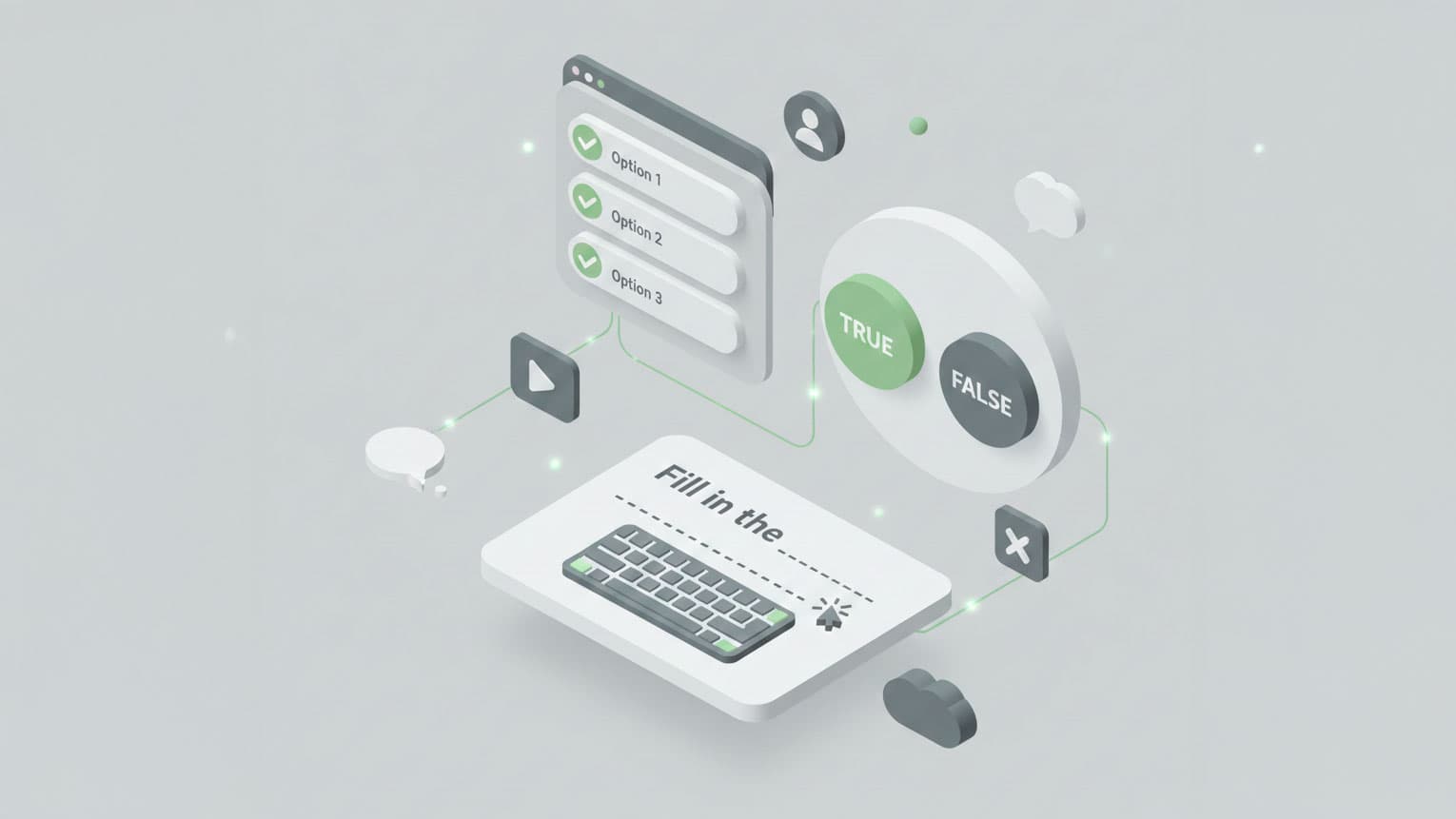
Acing exams isn't about studying harder—it's about studying smarter. While many students still rely on passive methods like re-reading notes and highlighting, decades of cognitive science research reveals that specific evidence-based techniques dramatically improve exam performance and long-term retention. This comprehensive guide explores 10 scientifically proven study methods you can implement immediately, with practical strategies for integrating them into your MintDeck learning workflow.
1. Active Recall: The Most High-Yield Study Method
What it is: Active recall involves forcing your brain to retrieve information from memory by testing yourself repeatedly, rather than passively reviewing material. Instead of re-reading your notes or textbook, you create questions based on the material and attempt to answer them without looking at the source.
Why it works: Active recall activates what researchers call the "testing effect," which moves information from short-term memory into long-term memory far more efficiently than passive review. When you actively retrieve information, your brain strengthens the neural pathways associated with that knowledge, making it easier to access during exams.
Research ranks active recall as the highest-utility study technique across all subjects and learner levels. Studies consistently show that students using active recall significantly outperform those relying on passive techniques like re-reading.
How to implement with MintDeck: MintDeck is built specifically for active recall. Create flashcard decks covering your exam material, focusing on key concepts, definitions, formulas, and problem types. Use the app's spaced repetition algorithm to review cards at optimal intervals. Instead of reviewing all cards at once, let MintDeck prioritize cards you find challenging. When you flip a card, force yourself to recall the answer before revealing it—that moment of retrieval is where the learning magic happens.
2. Spaced Repetition: Review at the Right Time
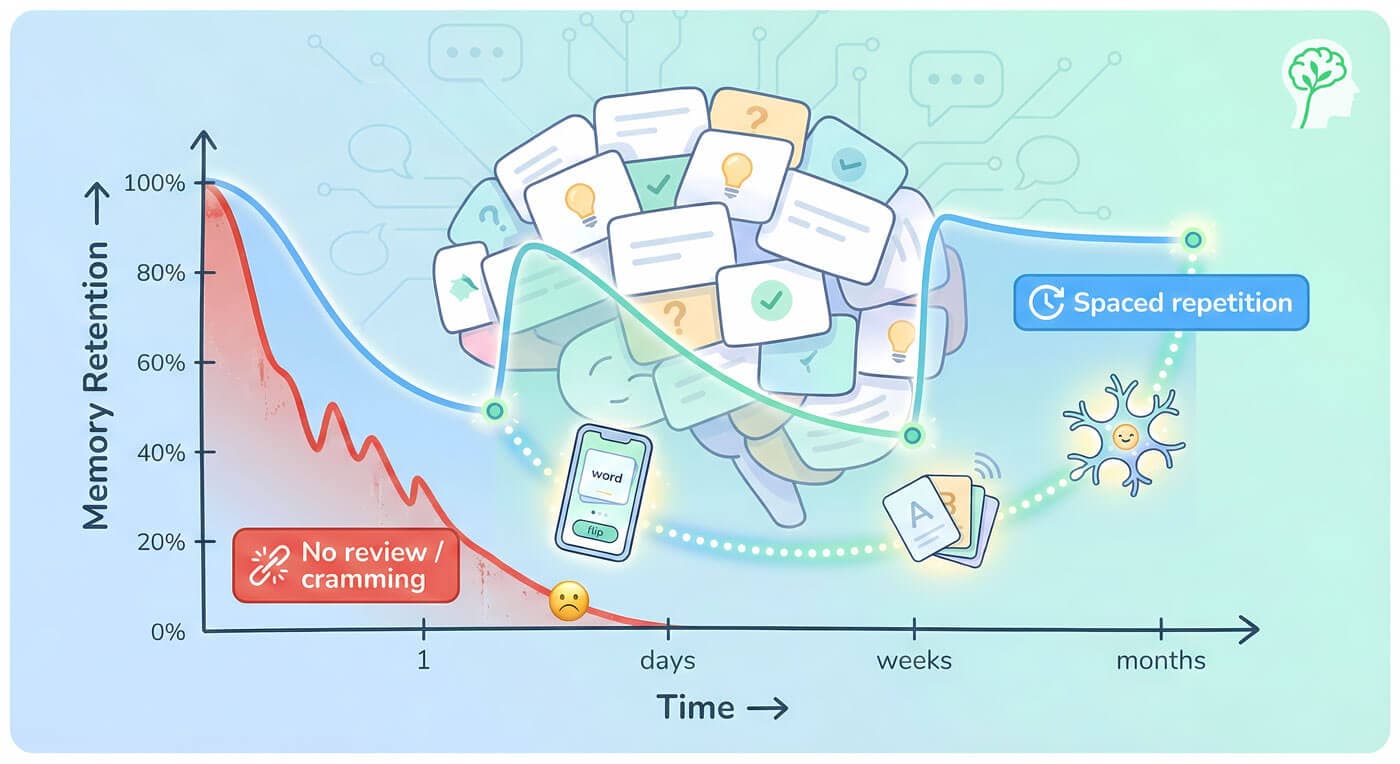
What it is: Spaced repetition involves reviewing information at increasingly longer intervals rather than cramming all study sessions together. Instead of studying something once and moving on, you encounter the same material multiple times—but with strategic gaps between reviews.
Why it works: The spacing effect demonstrates that learning improves dramatically when study sessions spread out over time. When you space out your learning, your brain encodes information in different ways and creates multiple retrieval pathways, making the knowledge more accessible. Research shows that distributed practice produces moderate to substantial improvements in retention compared to massed practice, with effect sizes of 0.54 across classroom studies. For a deep dive into the neuroscience behind this phenomenon, see our article on the science of spaced repetition.
How to implement with MintDeck: MintDeck's core algorithm implements spaced repetition automatically. The app intelligently schedules cards based on your performance, showing you material just as you're about to forget it. This is the science behind why MintDeck helps you retain information for longer with fewer total study hours. Set a consistent daily study routine—even 15-20 minutes daily with MintDeck beats cramming sessions the night before exams.
3. The Feynman Technique: Teach to Learn
What it is: The Feynman Technique involves explaining a concept in simple terms as if teaching it to someone with no background knowledge. You identify gaps in your understanding and fill them in by studying those areas more deeply.
Why it works: By forcing yourself to explain concepts simply and clearly, you identify what you genuinely understand versus what you've only memorized. Research demonstrates that the Feynman Technique produces a large effect size (Cohen's d = 0.87) on comprehension, with 73% of students reporting improved understanding. The technique works because it requires elaboration—connecting new information to existing knowledge.
How to implement with MintDeck: When creating flashcards, write explanations that you could teach to someone unfamiliar with the topic. For complex concepts, use MintDeck's note feature to write detailed explanations. Before each exam, spend time explaining key concepts aloud—pretend you're teaching a friend. If you stumble over an explanation, that reveals a knowledge gap worth studying further with MintDeck's targeted review.
4. The Pomodoro Technique: Work Smarter, Not Just Longer
What it is: The Pomodoro Technique divides work into focused 25-minute intervals separated by 5-minute breaks, with a longer break (15-30 minutes) after four cycles.
Why it works: Your brain has limited cognitive resources, and prolonged concentration drains mental energy without breaks. The Pomodoro Technique prevents burnout by aligning with your brain's natural attention cycles. Time pressure during work sessions triggers norepinephrine, maintaining sharp focus, while breaks allow acetylcholine to replenish, preventing cognitive burnout. Each completed cycle produces a sense of progress and achievement, which reinforces motivation through dopamine release.
How to implement with MintDeck: Combine MintDeck study sessions with the Pomodoro Technique. Study with your MintDeck app for 25 minutes—work through as many cards as you can while maintaining focus. Take a 5-minute break (stretch, hydrate, look away from screens). After four 25-minute cycles, take a longer break. This structured approach prevents the mental fatigue that often derails longer study sessions. For more strategies on building sustainable study habits, check out our guide on creating a productive study schedule.
5. Interleaving: Mix Your Topics
What it is: Interleaving involves mixing different topics or types of problems during a single study session, rather than blocking practice (studying one topic thoroughly before moving to another). Instead of doing all algebra problems, then all geometry problems, you alternate between different problem types.
Why it works: Interleaving improves long-term retention and transfer of learning compared to blocked practice. When you interleave topics, your brain must continuously discriminate between different concepts and problems, which strengthens your understanding of how they differ and relate. Research shows interleaving produces better performance on tests and in real-world applications, even though it feels more challenging during study sessions.
How to implement with MintDeck: Instead of creating separate decks for each topic, create one comprehensive deck for your subject. Mix cards from different chapters, topics, and problem types. When MintDeck presents cards in random order, this naturally creates interleaving. Your brain must constantly switch between different concepts, strengthening your ability to recognize which approach applies to different scenarios—exactly what exam questions require.
6. Elaboration: Connect Information
What it is: Elaboration involves connecting new information to what you already know, explaining how concepts relate to each other, and thinking about practical applications. Instead of memorizing facts in isolation, you build connections across concepts.
Why it works: When you elaborate on information, you create richer memory representations with multiple retrieval pathways. Elaboration helps you understand not just what information means, but why it matters and how it connects to other concepts. This deeper understanding transfers better to new situations and exam questions that test conceptual knowledge.
How to implement with MintDeck: When creating cards, include context and connections. Instead of just "Mitochondria: powerhouse of the cell," write "Mitochondria are the powerhouse of cells because they convert glucose and oxygen into ATP through cellular respiration—the energy all cells need to function. This is why cells doing high-energy activities (muscle cells, sperm) have many mitochondria." This elaborated explanation helps you understand relationships, not just memorize definitions.
7. Cornell Note-Taking System: Structured Note Organization
What it is: The Cornell Note-Taking System divides your page into three sections: notes (right column for main lecture content), cues (left column for questions and key terms), and summary (bottom section summarizing the page). You take notes during class, then review and organize them afterward.
Why it works: Cornell note-taking is the most effective note-taking strategy for enhancing information retrieval and test performance. Research shows Cornell note-takers score 10-12% higher on average than students using other methods. The system works because it forces active organization during review—converting passive notes into structured study material.
How to implement with MintDeck: Use the Cornell system when taking notes in class, then convert your organized notes into MintDeck flashcards. The cue column (questions) becomes your flashcard fronts, and the notes section becomes the answers. This two-step process—organizing with Cornell, then converting to MintDeck flashcards—ensures your notes are optimally structured for active recall study.
8. Metacognition and Self-Monitoring: Know What You Know
What it is: Metacognition is thinking about your own thinking—monitoring your understanding, identifying knowledge gaps, and strategically adjusting your study methods. Instead of assuming you understand something, you actively assess your comprehension and adjust accordingly.
Why it works: Metacognitive monitoring helps you allocate study time efficiently to areas needing improvement. Students who engage in retrieval practice while monitoring their understanding develop heightened awareness of their progress and adjust their strategies based on actual performance rather than intuition. This prevents the common problem where students feel confident about material they haven't actually learned.
How to implement with MintDeck: Pay attention to which cards you struggle with in MintDeck. When you mark a card as "hard," recognize that as a genuine knowledge gap worth additional study. Use this data to guide your review priorities. Before exams, use MintDeck's progress metrics to identify weak areas, then create additional cards focusing specifically on those concepts. Your actual performance data is more reliable than your intuition about what you know.
9. Pre-Testing: Begin Before You Learn
What it is: Pre-testing involves taking a quiz or test on material before you study it, rather than only testing after learning. Even though you'll likely answer incorrectly, the act of attempting to retrieve information primes your brain for learning.
Why it works: Pre-testing activates prior knowledge and increases attention to related material during subsequent learning. Research shows that pre-testing produces approximately a 10% improvement (a full letter grade) on related material on the final exam. Pre-testing works through multiple mechanisms: increased attention to pretested material during learning, deeper encoding of new information, and spaced retrieval effects from seeing material multiple times.
How to implement with MintDeck: Before starting a new chapter or topic, create a preview deck with basic questions covering upcoming material. Spend 5-10 minutes attempting to answer these cards without worrying about accuracy. Then study the material normally using MintDeck's full flashcard system. The pre-exposure primes your brain, and your subsequent learning will be deeper and more durable.
10. Dual Coding: Combine Visuals and Words
What it is: Dual coding combines visual information (diagrams, images, flowcharts) with verbal information (text, narration, explanations). When learners encounter both simultaneously, each system builds a mental representation of the same concept.
Why it works: Dual coding creates two mental "paths" to the same content, doubling retrieval opportunities. When you remember an image, it can trigger the associated words, or vice versa. This network of mental associations makes information stickier and easier to recall. Learners absorb and retain information more effectively when visuals and language are intentionally aligned. Dual coding also reduces cognitive overload by dividing information across visual and verbal processing systems rather than overwhelming one channel.
How to implement with MintDeck: When creating flashcards, include diagrams, flowcharts, or visual descriptions alongside text explanations. For anatomy, create cards with labeled diagrams. For historical events, include relevant images. For scientific processes, draw the stages. For mathematical concepts, use visual representations of the math. The combination of visual and verbal encoding strengthens memory significantly compared to either alone.
Combining Techniques for Maximum Effect
The most powerful approach isn't using these techniques in isolation—it's strategically combining them. A winning study system might look like this:
Before learning: Use pre-testing with MintDeck to activate prior knowledge and prime your brain (Technique 9).
During class: Take organized notes using the Cornell System, converting lectures into structured material (Technique 7).
During review: Create MintDeck flashcards that implement active recall (Technique 1), spaced repetition (Technique 2), interleaving (Technique 5), and dual coding (Technique 10). Use the Pomodoro Technique to structure your study sessions (Technique 4).
Advanced learning: Apply the Feynman Technique by explaining concepts from your cards (Technique 3), elaborate on connections between cards (Technique 6), and use metacognition to identify and focus on weak areas (Technique 8).
Why MintDeck Implements These Techniques
MintDeck is purpose-built to incorporate the most powerful study techniques from cognitive science:
- Active Recall: Every card interaction requires you to retrieve information from memory
- Spaced Repetition: The algorithm automatically schedules optimal review timing
- Interleaving: Cards appear in random order, mixing different topics
- Dual Coding: Support for images, audio, and text on cards
- Metacognition: Progress tracking helps you monitor understanding and identify gaps
By combining MintDeck's inherent structure with the study techniques above, you transform scattered study sessions into a strategic, scientifically-optimized learning system.
Key Takeaway
Research overwhelmingly shows that active recall paired with spaced repetition dramatically outperforms passive study methods. These aren't minor improvements—they represent the difference between barely passing and acing exams. The techniques in this guide aren't theoretical—they're proven in hundreds of peer-reviewed studies across diverse subjects and learner populations. Start implementing them today with MintDeck, and you'll notice significant improvements in both exam performance and long-term retention. If you're just starting college, our freshman guide to effective learning covers how to apply these techniques in a college environment.
This article synthesizes findings from peer-reviewed cognitive science research, educational psychology journals, and learning science meta-analyses. All claims are supported by primary research from institutions including leading universities and cognitive research centers.
Written by
Sergiu Puscas · Creator of MintDeck
Sergiu builds MintDeck and writes every guide and comparison on this blog — drawing on building an FSRS-based flashcard app and hands-on testing of the study apps covered here.
More about Sergiu