Learning isn't just about exposure to information—it's about testing yourself against that information. While flashcards have been the foundation of effective spaced repetition, interactive quizzes take learning to the next level by combining multiple question formats, adaptive difficulty, and objective feedback in a way that passive review simply cannot match.
This is where MintDeck Quizzes come in. By transforming your existing flashcard decks into dynamic assessments, quizzes unlock a more powerful learning mechanism: the testing effect. In this article, we'll explore the science behind why quizzes work, how different question types accelerate learning, and why combining quizzes with flashcards creates an unbeatable study system.
The Problem with Flashcards Alone: Why You Need More Than Repetition
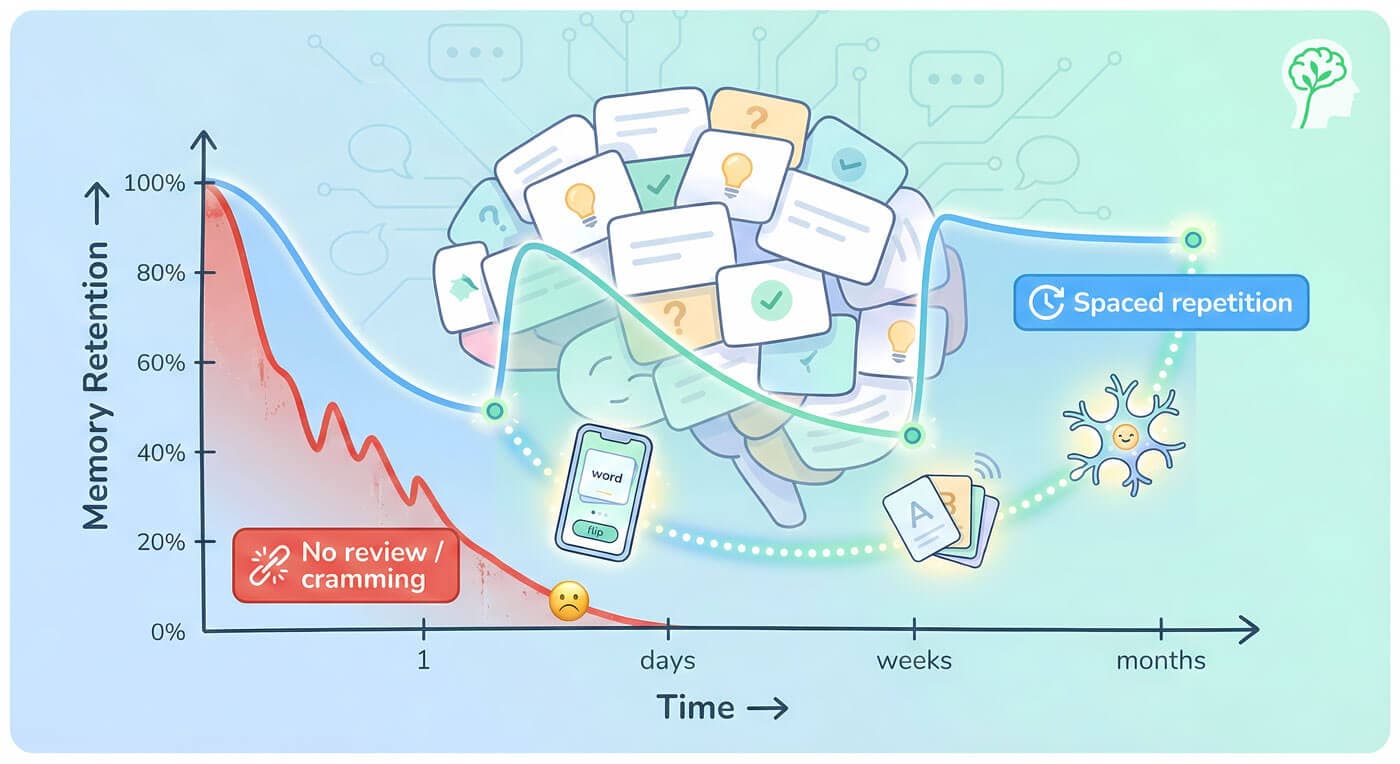
Flashcards are powerful. The spaced repetition algorithm has decades of research backing it, and apps like MintDeck have made it more accessible than ever. But here's the uncomfortable truth: reviewing flashcards is still recognition-based learning.
When you flip a card and see the question, you're recognizing the answer within a familiar context. You decide whether you "know" it or not—a process vulnerable to self-deception. This creates what cognitive scientists call the fluency illusion: you feel confident about material because it looks familiar, even though you couldn't retrieve it without the card in front of you.
Real exams, real conversations, and real application don't give you the luxury of recognition. They demand active recall—pulling information from your memory without external cues.
The gap between flashcard confidence and real-world performance is real, and quizzes are specifically designed to close it.
The Science Behind Why Quizzes Work: The Testing Effect
One of the most robust findings in learning science is called the testing effect. Study after study confirms that simply testing yourself on material produces significantly better long-term retention than reviewing the same material passively.
The numbers are striking. Research by Karpicke and Roediger (2008) found that students who tested themselves after learning retained 80% of material, compared to just 30% for students who only reviewed content. This isn't a marginal improvement—it's a fundamental difference in how your brain consolidates information.
Here's why quizzes trigger this effect:
1. Retrieval Practice Strengthens Memory When you answer a quiz question, your brain doesn't just recognize the answer—it actively retrieves it from memory. Each retrieval attempt, even failed ones, strengthens the neural pathways associated with that information. This is why the effort of trying to answer (and getting it wrong) still helps you learn better than passively reviewing the material.
2. Spaced Retrieval Creates Durable Long-Term Learning The spacing effect is arguably one of the largest and most robust findings in learning research. But spacing isn't just about timing—it works best when combined with retrieval. When you quiz yourself periodically on spaced-out material, you're not just reviewing; you're retrieving. This dual action creates learning that lasts.
3. Quizzes Reveal What You Actually Know Passive learners consistently overestimate their knowledge. When you re-read material, familiarity creates confidence. But quizzes reveal the truth: they expose exactly what you can and cannot retrieve under realistic testing conditions.
4. Active Engagement Increases Cognitive Processing When you engage with content interactively—by answering quiz questions, considering multiple options, and thinking critically about answers—your cognitive engagement increases significantly, leading to improved knowledge retention. This active participation is fundamentally different from the passive processing of reviewing flashcards.
Multiple Question Types, Multiple Cognitive Benefits
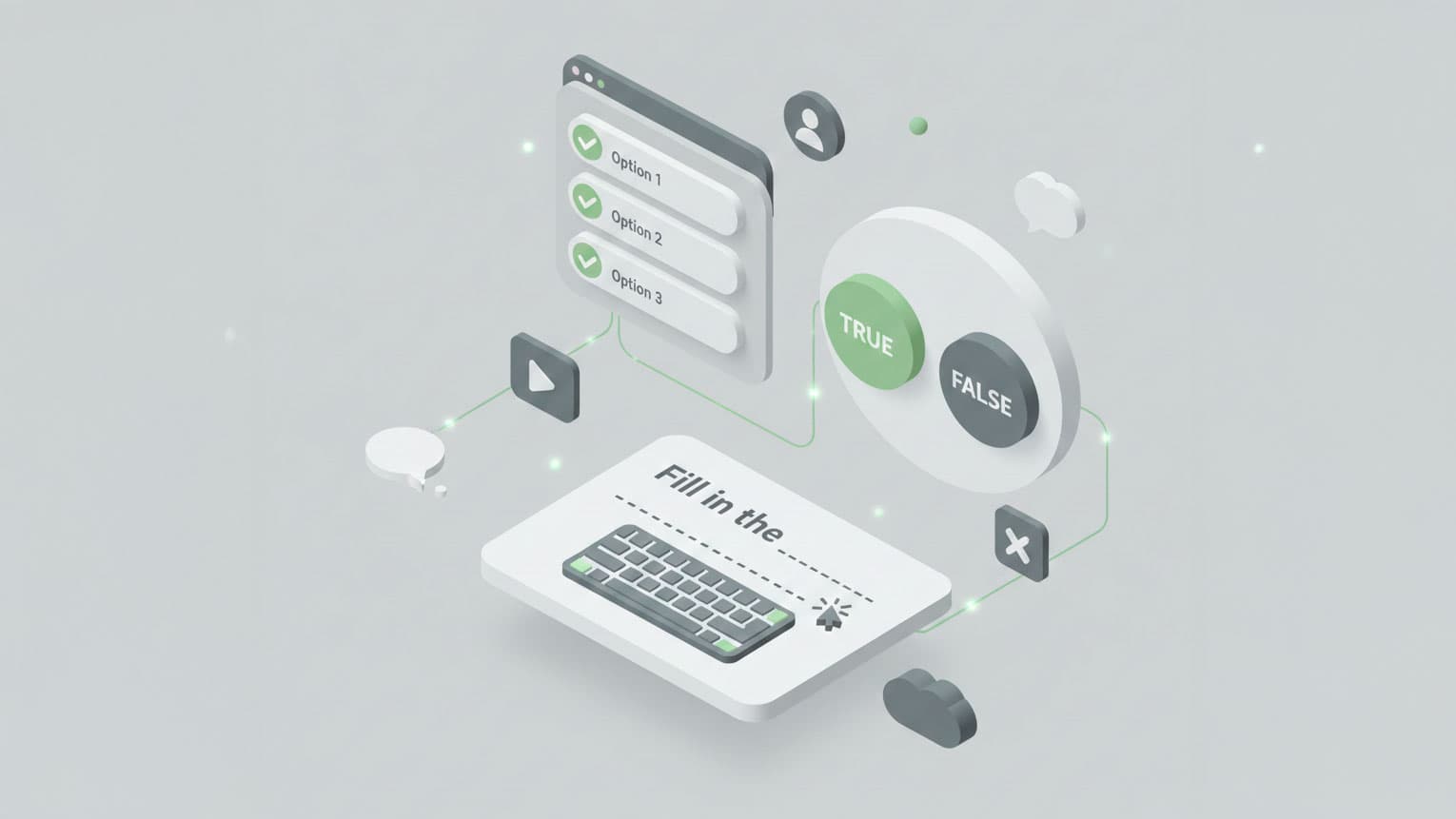
Not all quiz questions are created equal. Different formats activate different cognitive processes, each with unique learning benefits. MintDeck's three-format approach addresses this:
Multiple Choice: Recognition Plus Elimination Strategy
Multiple choice questions test more than simple recognition. When a question includes intelligent distractors (wrong answers that feel plausible), it forces you to think critically about why the correct answer is better than the alternatives.
This format is particularly effective because:
- It challenges your understanding at a deeper level than simple recognition
- It mirrors real-world assessment formats (standardized tests, certification exams, professional evaluations)
- It eliminates pure guessing through carefully crafted alternatives
- It teaches you to distinguish between similar concepts
For language learners, MintDeck's AI-powered generation specifically avoids tricky distractors (like cognates that look similar but aren't correct translations), forcing you to genuinely understand the material.
Fill in the Blank: Active Recall in Context
Fill-in-the-blank questions demand production—you must generate the answer, not just recognize it. This is closer to how you'll actually use the knowledge.
Why this matters:
- Production vs. recognition: Production tests (like fill-in-the-blank) produce superior learning outcomes compared to recognition tests
- Vocabulary retention: For language learning, completing sentences with missing words tests vocabulary in realistic context
- Active memory process: Students must recall and construct the answer, leading to deeper consolidation
True/False: Critical Evaluation and Misconception Detection
True/false questions might seem simple, but they're cognitively demanding in a different way. They force you to evaluate statements critically and distinguish between correct information and subtle misconceptions.
Benefits include:
- Testing conceptual understanding and critical thinking
- Identifying and correcting misconceptions before they calcify
- Rapid assessment of broad knowledge areas
- Low anxiety format that reduces test-taking stress while maintaining learning benefits
Adaptive Difficulty: The Goldilocks Principle for Learning
One reason traditional flashcards can feel tedious is that the difficulty never adjusts to your ability. You might breeze through cards you already know while spending precious time on things you've nearly mastered.
MintDeck Quizzes' adaptive difficulty system solves this by using Item Response Theory (IRT)—the same algorithm underlying professional standardized tests like the SAT and GRE.
Here's how it works:
Easy Mode builds confidence by presenting simpler questions, crucial for learners who need initial momentum and encouragement.
Medium Mode provides balanced challenge, making it ideal for steady, sustainable progress.
Hard Mode tests mastery by focusing on challenging material, perfect for learners preparing for high-stakes assessments.
Adaptive Mode (Default) automatically adjusts difficulty in real-time, targeting approximately a 70% success rate. This "sweet spot" is based on decades of learning science:
- At 70% success, you're challenged enough to strengthen memory without becoming frustrated
- Questions that are too easy don't strengthen memory as effectively
- Questions that are too hard lead to frustration and disengagement
- Adaptive difficulty automatically expands as you improve, ensuring the challenge never plateaus
This dynamic adjustment is why quiz-based learning feels more engaging than static flashcard review—your brain is always operating at the edge of its current ability, which maximizes learning efficiency.
From Quiz Results to Learning Action: The Feedback Loop
Here's where quizzes pull ahead of flashcards: they provide objective, actionable feedback.
When you finish a MintDeck quiz, you don't just see a score. You get:
- A letter grade (A-F) with accuracy percentage—immediate objective measurement of performance
- Time analytics—total time and average per question, helping you identify where you're getting stuck
- Question type breakdown—revealing which formats challenge you most (maybe you're strong at multiple choice but weak at fill-in-the-blank)
- Exact missed cards list—you know precisely what to review
- One-tap review—immediately study the cards you missed while they're fresh in working memory
This isn't just feedback; it's a learning map. Each quiz tells you exactly where to focus.
Compare this to traditional flashcard review, where progress tracking is vague (how many times did you see that card?) and it's unclear what you actually failed to retain.
Complementing Flashcards: The Optimal Learning Routine
Here's the key insight: quizzes don't replace flashcards. They amplify them.
The ideal learning progression looks like this:
Phase 1: Initial Learning Use flashcards to absorb new information and build familiarity. Spaced repetition here is crucial for initial encoding.
Phase 2: Consolidation Continue flashcard review with your app's spaced repetition algorithm. At this stage, you're moving information from short-term to long-term memory.
Phase 3: Testing and Assessment Once you've reviewed material multiple times through flashcards, use quizzes to test real retrieval ability. This is where the testing effect kicks in hardest—you're now demanding active recall instead of passive recognition.
Phase 4: Targeted Review Focus flashcard study on cards you missed in quizzes. Because you now know exactly what you don't know, your review becomes laser-focused.
Phase 5: Mastery Validation Take another quiz with harder difficulty or adaptive mode. This isn't just a test—it's confirmation that your knowledge transfer to new contexts.
This cycle combines the best of both worlds: flashcards' systematic spacing schedule with quizzes' powerful testing effect.
The Multiple Benefits of Interactive Quizzes
Beyond learning science, quizzes deliver practical benefits across different learning contexts:
For Language Learners
Language learning demands production—you need to generate output, not just recognize input. MintDeck Quizzes' fill-in-the-blank format specifically tests vocabulary in context, with AI generation that understands language pairs and avoids tricky cognate distractors. This produces superior transfer to real conversation.
For Students
Objective assessment is invaluable for exam preparation. Multiple choice and true/false formats mirror standardized tests, and performance tracking across time shows genuine progress—not just familiarity. Quizzes become practice exams that actually improve performance.
For Professionals
Certification and compliance testing demands quick, objective proof of knowledge. Quizzes provide this while helping identify knowledge gaps through performance breakdowns by question type. A professional can quiz themselves on a topic in 5-50 minutes, exactly fitting real schedules.
For Self-Learners
Gamification (grades, performance metrics, improvement tracking) transforms learning from monotonous card-flipping into a more engaging, motivating experience. Objective feedback replaces the self-assessment bias that plagued traditional flashcard review.
Quizzes Make Learning More Interactive Without Replacing Flashcards
The future of effective learning isn't choosing between flashcards and quizzes—it's strategically using both.
MintDeck Quizzes transform your existing flashcard decks into dynamic assessments. You generate unlimited quizzes on-demand from any deck with three question types, adaptive difficulty, and detailed analytics. The on-device generation is free and instant; optional AI-powered generation creates synthesis questions that connect concepts.
What makes this powerful: you don't create content twice. Your flashcards become quizzes automatically. The infrastructure you've already built (your decks) suddenly becomes a testing engine.
The science is clear—the testing effect is one of the largest and most robust findings in learning research. Multiple question types engage different cognitive processes. Adaptive difficulty keeps you in the optimal challenge zone. Objective feedback reveals exactly what you know and don't know.
When you combine MintDeck's spaced repetition flashcards with interactive quizzes, you're building a learning system grounded in decades of cognitive science research.
Start Testing Your Knowledge Today
Your next breakthrough in learning might not come from reviewing more flashcards—it might come from testing yourself on them.
Quiz yourself today. See how quizzes reveal the difference between recognition and retrieval. Experience how multiple question types challenge your understanding in new ways. Use adaptive difficulty to stay in that optimal 70% success zone. Let objective feedback guide your study focus.
The testing effect is waiting. Generate a quiz from your favorite deck right now.
FAQs About Interactive Quizzes and Learning
Q: Will quizzes replace my flashcard routine? A: No. Quizzes and flashcards work best together. Use flashcards for initial learning and spaced repetition, then use quizzes periodically to test real retrieval ability and identify weak areas.
Q: How often should I quiz myself? A: There's no single answer—it depends on your learning goals. For exam preparation, frequent quizzing (weekly or bi-weekly) is ideal. For long-term retention, quizzing less frequently but regularly (monthly) maintains knowledge without excessive time investment.
Q: What's the ideal difficulty level? A: Adaptive difficulty (the default) automatically adjusts to your performance, keeping you at approximately 70% success rate. This is the sweet spot for learning—challenging enough to strengthen memory without causing frustration.
Q: How accurate is the AI-powered question generation? A: AI-powered generation (5 credits per quiz) creates higher-quality, more varied questions including synthesis questions that connect multiple cards. On-device generation (free) uses NLP-based question creation, which is instant and works offline. Both methods are effective; choose based on your quality preferences and credit availability.
Q: Can I see which specific cards I missed? A: Yes. After each quiz, you get a complete list of missed cards with one-tap review, letting you immediately study exactly what you didn't know.
Q: Do quizzes help with long-term retention? A: Absolutely. Research shows testing produces significantly better long-term retention (80%+) compared to passive review (30%). The testing effect is one of the most robust findings in learning science.
Q: Is fill-in-the-blank harder than multiple choice? A: Generally, yes. Production-based testing (fill-in-the-blank) is more cognitively demanding than recognition-based testing (multiple choice) because you must generate the answer rather than recognize it. However, this difficulty is exactly why fill-in-the-blank produces superior learning outcomes.
References and Further Reading
For readers interested in the cognitive science behind these recommendations:
- Karpicke, J. D., & Roediger, H. L. (2008). The critical importance of retrieval practice. Psychological Review, 115(1), 213-243.
- Rohrer, D., & Taylor, K. (2007). The shuffling of mathematics problems improves learning. Instructional Science, 35(6), 481-498.
- Dunlosky, Y., Rawson, K. A., Marsh, E. J., Nathan, M. J., & Willingham, D. T. (2013). Improving students' learning with effective learning techniques. Psychological Science in the Public Interest, 14(1), 4-58.
Last updated: December 2025
Related reading: The science of spaced repetition · Why FSRS outperforms SM-2 · Best free flashcard app for iPhone
Written by
Sergiu Puscas · Creator of MintDeck
Sergiu builds MintDeck and writes every guide and comparison on this blog — drawing on building an FSRS-based flashcard app and hands-on testing of the study apps covered here.
More about Sergiu