If you're prepping for the GRE, you've probably already opened a browser tab, a Magoosh subscription, and a Kaplan book on the same afternoon. What's missing is usually the glue — the review system that takes all of those sources and turns them into durable memory before test day. That's what flashcards are for. The trick is choosing an app that holds up at GRE scale.
This guide compares the four apps serious GRE test-takers actually use in 2026 — MintDeck, Anki, Quizlet, and Magoosh — and walks through which one fits which section of the test, from Verbal vocabulary grinding to Quant formula review and AWA template work.
Why the choice matters more for GRE than most exams
The GRE is a six-month test for most people. By the time you sit down in August, September, or October, you'll have worked through 800 to 1,500 vocabulary words, 60+ quant formulas and shortcut patterns, and a handful of AWA essay templates. That's a card count where the scheduling algorithm stops being a detail and starts deciding whether your daily review queue is 25 minutes or 75.
The SM-2 algorithm that most flashcard apps still ship with (including stock Quizlet) was designed in 1987 for language learners. It doesn't know the difference between a word you saw once three weeks ago and a word you've reviewed correctly six times in a row.
FSRS — the Free Spaced Repetition Scheduler — was trained on millions of real reviews and is measurably better at predicting your personal forgetting curve. Anki adopted it as the default in late 2023. MintDeck uses it out of the box. For a test where every hour of study time matters and your test window might still be four months away, that efficiency compounds.
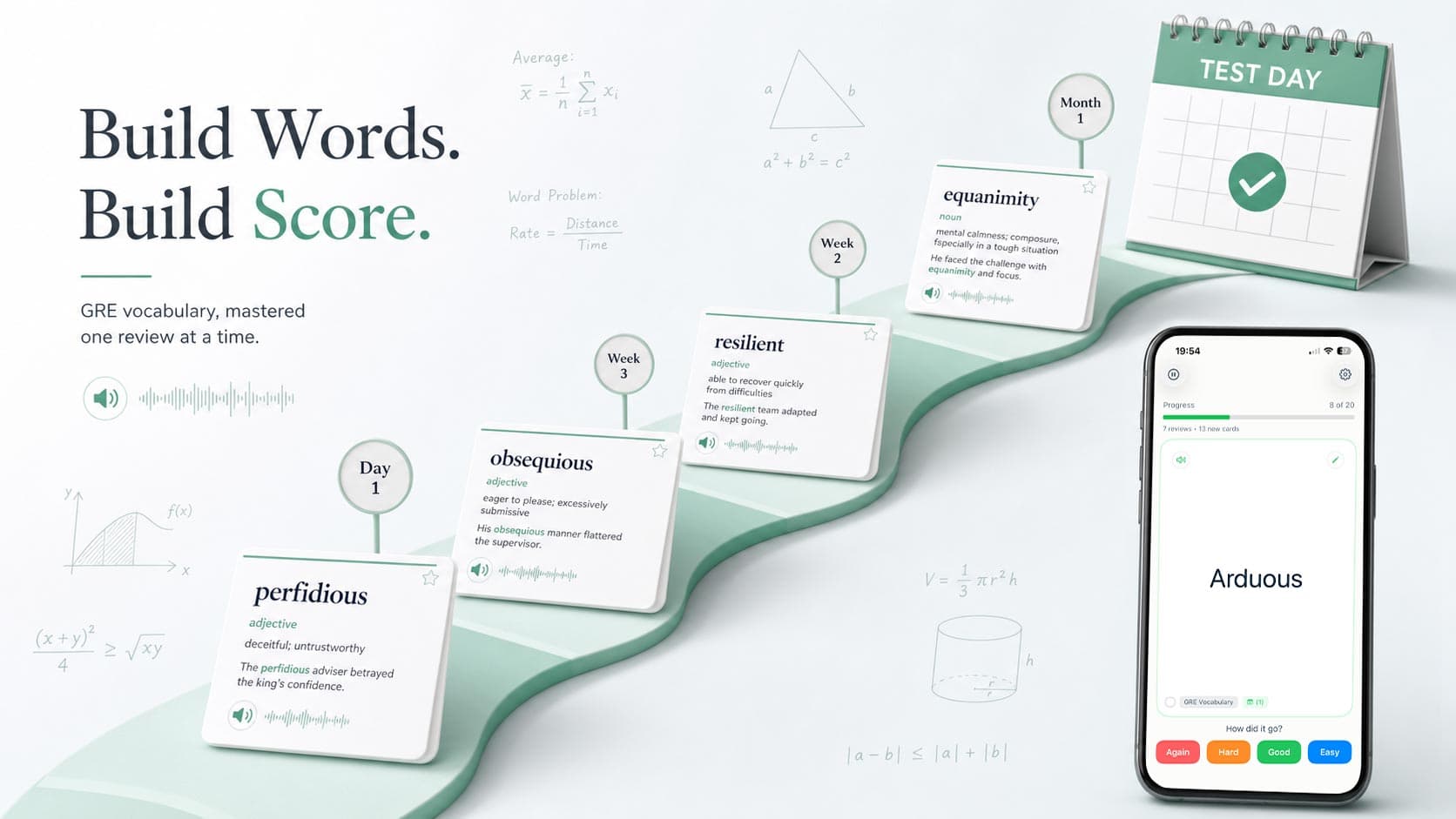
The other thing GRE is unusual for: the vocabulary needs to be pronounced correctly. Words like perfidious, obsequious, and supercilious show up on the test, and hearing them out loud while you study locks them in faster than reading alone.
MintDeck — best for GRE test-takers who want FSRS without the setup
MintDeck is an iOS flashcard app built around the same FSRS algorithm Anki uses, redesigned to work the way modern iOS apps are supposed to — tap to start, no add-ons to install, no card templates to configure.
Three features that matter specifically for GRE prep:
- AI deck generation from your study materials. Paste a Manhattan 5lb word list, a Magoosh 1000 vocab set, Kaplan quant formula sheets, or your own notes into the AI deck generator, and MintDeck builds a study deck in about 30 seconds. Always review the generated cards — LLMs occasionally get definitions slightly off — but it removes the "I know I should make cards for this chapter but don't have time" problem that stops most test-takers from using flashcards consistently.
- Free audio for pronunciation. On-device text-to-speech in 31 languages runs offline, and hearing perfidious, obsequious, supercilious, pusillanimous pronounced correctly while you study is genuinely helpful — the GRE disproportionately tests vocabulary most people have only seen in writing. No subscription required.
- Anki deck import. If you've already pulled down a community GRE deck — Magoosh 1000, GregMat, or one of the older Barron's-based sets — the
.apkgformat imports directly, with media and scheduling history preserved.
MintDeck is free to start — 10 AI generation credits included, and core studying (review, import, audio) stays free. Best fit for test-takers six-to-four months out who want modern scheduling without a weekend of setup, and for anyone balancing full-time work with prep who can't afford inefficient review sessions.
Anki — best if you want maximum customization and don't mind the learning curve
Anki is the community standard for a reason. FSRS is now the default, the add-on ecosystem is enormous (Image Occlusion Enhanced, AwesomeTTS, scheduling visualizers), and there are more pre-made GRE decks on AnkiWeb than any other platform.
The trade-off is setup. Card templates, field configuration, and deciding which add-ons you actually need all front-load your work. AnkiMobile on iOS costs $24.99 one-time; desktop is free. If you already have a deck workflow dialed in from a previous test or from a friend, staying on Anki is probably the right call.
Quizlet — best for casual drilling, not long-haul GRE prep
Quizlet is still the most recognizable name in flashcards, and the social/shared-set model is pleasant for browsing community GRE vocab lists. It falls short as a primary GRE tool for three reasons:
- Learn mode — the actual spaced-repetition mode — is behind the paid Quizlet Plus plan.
- It still uses an SM-2-style scheduler, not FSRS.
- There's no AI generation from your own notes; you're stuck with whatever community sets exist, and quality varies wildly.
Useful as a secondary tool for quick one-off drilling. Not the system you build a six-month GRE plan around.
Magoosh — best if you want curated GRE content and prefer a prep-course wrapper
Magoosh's flashcard app ships with a curated 1,000-word GRE vocab list, free, and it's genuinely well-edited. Their paid course ($129–$229 depending on plan and promos) bundles video lessons, practice questions, and the flashcards together, which makes it a reasonable all-in-one prep tool for people who want structure.
The downsides for serious test-takers:
- The scheduler isn't FSRS — it's a simpler spaced-repetition model. Fine for a fixed 1,000-word deck, less ideal if you expand beyond it.
- You can't add your own cards, import decks, or generate from notes. You're locked to Magoosh's curriculum.
- The monthly cost stacks on top of any other prep materials.
If you're already paying for Magoosh's full course and want the flashcards as part of that bundle, they're good. If you want to own your deck long-term, pair it with MintDeck or Anki.
2026 comparison: GRE-relevant features side-by-side
| Feature | MintDeck | Anki | Quizlet | Magoosh |
| FSRS scheduler | ✅ Default | ✅ Default | ❌ | ❌ |
| AI generation from your notes | ✅ | ❌ (manual or add-on) | ❌ | ❌ |
| Free audio / TTS (EN) | ✅ On-device | Add-on only | ✅ Limited | ✅ Pre-recorded |
Anki .apkg import | ✅ | Native | ❌ | ❌ |
| Curated GRE vocab set | Community sets via import | Community sets | Community sets | ✅ 1,000 words included |
| Offline study | ✅ | ✅ | Partial (pro) | Partial |
| Starting cost | Free (10 AI credits) | Free (desktop) / $24.99 iOS one-time | Free core; Learn needs paid Plus | $129–$229 course; free app-only tier |
Matching the app to the section
Verbal. GRE Verbal is the section where flashcards matter most. You're building a 1,000-to-1,500-word vocabulary deck and reviewing it every day for months. Use FSRS — either MintDeck or Anki — and turn on audio so you're hearing the words, not just reading them. AI generation helps here: take a Manhattan or Barron's list, paste it into the generator, and you've got a reviewable deck in a minute.
Quant. For formulas, shortcut patterns, and number-property facts, flashcards work well but are rarely enough on their own — pair them with timed practice problems from PowerPrep. Atomic cards beat wall-of-text cards: one formula per card, with a worked example on the back. Review daily for 10 minutes, not 45.
AWA. Flashcards are the wrong tool for essay writing, but they're good for locking in the scoring rubric, transition phrases, and common logical-flaw patterns (appeal to authority, false dichotomy, conflating correlation with causation). A 40-card "AWA patterns" deck reviewed over the last three weeks before test day is a surprisingly high-leverage investment.
Study tips that compound across all three sections
- Make cards atomic. One idea per card. "What is perfidious?" beats a paragraph of synonyms.
- Review daily, not in blocks. Fifteen minutes a day crushes a two-hour session once a week. That's what FSRS is optimized for.
- Hear the words. Turn on audio for Verbal cards; it locks in the sound alongside the meaning.
- Let AI generate the first pass, then edit. The AI generator saves the hour it takes to type out 200 cards. You still review everything — it's your deck.
- Don't abandon cards you keep missing. FSRS is specifically built to resurface them on the right day. Trust the algorithm and keep reviewing.
For deeper dives on the method: The science of spaced repetition, why FSRS outperforms SM-2, and how to build a productive study schedule pair well with the app choice.
The bottom line
If you're grinding GRE vocab and want modern scheduling without the Anki learning curve, MintDeck is probably the fastest path to a working study system. If you already use Anki and love the customization, keep using it — FSRS is in both apps. If you're inside the Magoosh ecosystem and happy there, use their 1,000-word set as a starting point and import it into MintDeck or Anki when you want to scale beyond it.
Whichever app you pick, the test isn't won by the tool — it's won by the number of consistent daily reviews you show up for between now and test day. The right app is the one that makes tomorrow morning's fifteen minutes likely to happen.
Try MintDeck's free AI flashcard generator →
Compare apps: MintDeck vs Anki · MintDeck vs Quizlet
Related exam prep: GMAT prep · MCAT flashcard apps · CFA Level 1 flashcard apps · CPA exam
Written by
Sergiu Puscas · Creator of MintDeck
Sergiu builds MintDeck and writes every guide and comparison on this blog — drawing on building an FSRS-based flashcard app and hands-on testing of the study apps covered here.
More about Sergiu